Blog

  • ACVA Committee Report on Indigenous Veterans

    ACVA Committee Report – Indigenous Veterans: From Memories of Injustice to Lasting Recognition | ACVA Rapport du Comité – Les vétérans autochtones : des souvenirs d’injustice à une reconnaissance durable


    (Le français suit)

    Good afternoon, (from 8 February 2019)

    Today, the House of Commons Standing Committee on Veterans Affairs tabled a report entitled: Indigenous Veterans: From Memories of Injustice to Lasting RecognitionView the full report.

    The report contains 12 recommendations:

    Recommendation 1

    That Veterans Affairs Canada commit to continuing to hire Indigenous staff, with the intention of reaching a number that is at least proportional to the number of Indigenous veterans who are served by the Department.

    Recommendation 2

    That the Canadian Armed Forces delegate to each Canadian Ranger Patrol Group sufficient financial authority to ensure that the group can quickly reimburse Canadian Rangers for personal equipment that is broken while they are using it on duty.

    Recommendation 3

    That Veterans Affairs Canada produce a pamphlet outlining its main programs and services in the most common Indigenous languages, and that this pamphlet be distributed to all Canadian Ranger patrols.

    Recommendation 4

    That Veterans Affairs Canada incorporate in all its communications to the general public, and in all its program outreach efforts, a message or a question like “Have you worn the uniform?” or “Have you served?” so that veterans can easily identify themselves as veterans.

    Recommendation 5

    That Service Canada add services provided by Veterans Affairs Canada to the list of services it promotes when its representatives travel to meet with communities in remote areas.

    Recommendation 6

    That Veterans Affairs Canada work with the territorial governments so that territorial service officers working in Northern communities are able to offer local direct access to Veterans Affairs Canada programs.

    Recommendation 7

    That Veterans Affairs Canada and the U.S. Department of Veterans Affairs pursue an agreement to ensure better coordination of programs and services available to Indigenous veterans and their families who served in the Canadian Armed Forces and now reside in the United States, and Indigenous veterans and their families who served in the United States’ Armed Forces and now reside in Canada, including access to the Military Family Resource Centres.

    Recommendation 8

    That Veterans Affairs Canada and Indigenous Services Canada ensure that the funding parameters for services provided to Indigenous veterans living on reserve do not create a disadvantage for them in comparison to other veterans.

    Recommendation 9

    That Veterans Affairs Canada provide the House of Commons Standing Committee on Veterans Affairs with an explanation of the reasons that a settlement agreement was not reached to compensate Métis veterans of World War II and their families.

    Recommendation 10

    That Veterans Affairs Canada continue working with Métis and Métis organizations to ensure that Métis veterans and their families have access to all benefits and settlements to which they are entitled, and to ensure the access as soon as possible.

    Recommendation 11

    That Veterans Affairs Canada take steps to bring together representatives from associations representing Indigenous veterans so that it can share information about its programs and help create an environment where they can regularly communicate their various concerns.

    Recommendation 12

    That Veterans Affairs Canada review the eligibility criteria of its programs that provide funding for war memorials so that remote communities wanting to honour the memory of their veterans are better able to do so.


    Aujourd’hui, le Comité permanent des anciens combattants de la Chambre des communes a déposé un rapport intitulé : Les vétérans autochtones : des souvenirs d’injustice à une reconnaissance durableConsultez le rapport en entier.

    Le rapport contient 12 recommandations :

    Recommandation 1

    Qu’Anciens Combattants Canada s’engage à continuer d’embaucher du personnel autochtone, avec l’intention d’atteindre un nombre au moins proportionnel au nombre de vétérans autochtones qui sont clients du Ministère.

    Recommandation 2

    Que les Forces armées canadiennes délèguent à chacun des Groupes de patrouilles des Rangers canadiens une autorité financière suffisante pour leur permettre de rembourser rapidement les bris d’équipements personnels utilisés par les Rangers canadiens lorsqu’ils sont en service.

    Recommandation 3

    Qu’Anciens Combattants Canada produise une brochure présentant ses principaux programmes et services dans les principales langues autochtones, et que cette brochure soit distribuée à toutes les patrouilles des Rangers canadiens.

    Recommandation 4

    Qu’Anciens Combattants Canada incorpore dans toutes ses communications à large public, et dans tous ses efforts de sensibilisation (outreach) à ses programmes, un message ou une question, comme « Avez-vous déjà porté l’uniforme ? » ou « Avez-vous déjà servi ? » permettant aux vétérans de s’identifier aisément comme vétérans.

    Recommandation 5

    Que Service Canada ajoute les services offerts par Anciens Combattants Canada à la liste des services regroupés qu’elle fait connaître lorsque ses délégations se déplacent pour rencontrer les communautés en régions éloignées.

    Recommandation 6

    Qu’Anciens Combattants Canada entreprenne des démarches auprès des gouvernements des territoires afin que les agents de services territoriaux travaillant au sein des communautés du Nord soient en mesure d’offrir localement un accès direct aux programmes d’Anciens Combattants Canada.

    Recommandation 7

    Qu’Anciens Combattants Canada, le ministère de la Défense nationale et le département américain des Anciens combattants recherchent une entente permettant une meilleure coordination des programmes et services pouvant être offerts aux vétérans autochtones ayant servi dans les Forces armées canadiennes et vivant aux États-Unis, et les vétérans autochtones et leur famille ayant servi dans les Forces armées américaines et vivant au Canada, y compris l’accès aux Centres de ressources pour les familles des militaires.

    Recommandation 8

    Qu’Anciens Combattants Canada et Services aux Autochtones Canada s’assurent que les paramètres de financement des services offerts aux vétérans autochtones vivant dans les réserves ne les désavantagent pas en comparaison des autres vétérans.

    Recommandation 9

    Qu’Anciens Combattants Canada dépose au Comité permanent des anciens combattants de la Chambre des communes une explication des raisons empêchant la conclusion d’une entente concernant les revendications des vétérans métis de la Deuxième Guerre mondiale et de la guerre de Corée, ainsi que leurs familles.

    Recommandation 10

    Qu’Anciens Combattants Canada continue de collaborer avec les Métis et les organisations métisses pour veiller à ce que les anciens combattants métis et leurs familles aient accès à tous les avantages et règlements auxquels ils ont droit, et ce, dès que possible.

    Recommandation 11

    Qu’Anciens Combattants Canada entreprenne des démarches afin de réunir les représentants des associations représentant les vétérans autochtones afin de mieux faire connaître ses programmes et de créer des conditions propices au maintien de communications régulières reflétant la diversité de leurs préoccupations.

    Recommandation 12

    Qu’Anciens Combattants Canada revoie les critères d’admissibilité de ses programmes de soutien financier à l’érection de monuments commémoratifs afin de pouvoir mieux aider les communautés vivant en régions éloignées qui souhaitent honorer la mémoire de leurs vétérans.
     

  • Letter from the President – March 2019

    Our organization has been keeping busy over the past year leading into 2019.  We have established ourselves on 3 Advisory Boards of Veterans Affairs Canada and although it may appear little has been accomplished by the government, we have managed to see some movement on the issues.  I would recommend that all members keep looking to our website for information.


    I wish to thank John Jewitt, on behalf of all members, for the extremely hard work he has done over the

    Photo Credit: Able Seaman Anne-Marie Brisson
    Canadian Forces Support Unit (Ottawa) Imaging Services
    © 2018 DND-MDN Canada

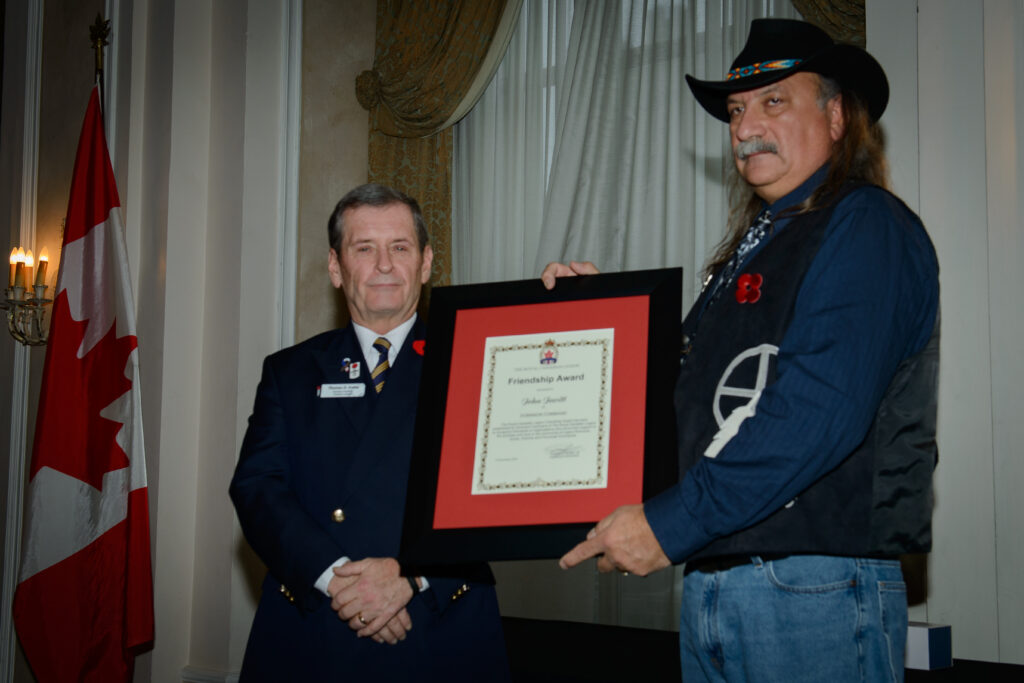
    past 2 months to give our website its new look.  I know it looks more professional and he will ensure that it is updated or upgraded as required.  I would ask all Directors to send writeups and pictures of activities and events in your area so that we can display them on the website for everyone to see.  Also, regarding John, he was honoured at the Silver Cross Luncheon with the Royal Canadian Legion Friendship Award which recognizes his work with the Legion on a host of projects, offering sound advice on Aboriginal protocols and reaching out to all Veterans.  He provided advice and guidance in the development and desing to the  2013 Year of the Aboriginal Veteran Legion pin which has turned out to be the best selling pin produced by the Legion


    Recently myself, John Jewitt, Devin Beaudry and Debbie Eisan were invited to a meeting in Winnipeg with the Veterans Transition Network.  They are trying to institute and Aboriginal component to their program which will help our Veterans and hopefully other non-Aboriginal Veterans.  The discussions centered on ensuring that what they do is in direct consultation with our Veterans (AVA) as well as respected and recognized Elders from all 3 of the groups on Canada.  I believe this will take time for them to create a meaningful program which answers the needs of transitioning members of the CAF and will assist those who may suffer from physical and/ or mental injuries.


    I have been invited to attend the National PTSD conference being held in Ottawa in early April.  This is being sponsored by the Health Canada and the Public Health Agency of Canada.   This is key to any development of strategy to deal with PTSD and also suicides within the Veterans community, CAF, Fire Fighter, Police and other EMS agencies.  This is a start and we should be extremely happy that AVA has been invited.


    I would ask our membership to continue working hard and should there be a need or requirement that requires my direct input do not hesitate to contact me.


    Miigwetch, Marsee, Merci, Qujannamiik, All our Relations


    Robert Thibeau, CD


  • Aboriginal veterans recognized at 31st annual Algonquins of Pikwakanagan Pow Wow

    GOLDEN LAKE – Powerful drum beats and singing were the heartbeat that led the dancers in their colourful regalia around the grounds at the 31st annual Algonquins of Pikwakanagan Traditional Powwow.
    Indigenous people from across the region, Quebec and parts of the United States traveled to the reserve at Golden Lake this past weekend for the annual, late summer event which is both a celebration and a sacred rite.
    In addition, hundreds and hundreds of visitors flooded the grounds, curious about this cultural gathering. Everyone was quickly swept up in the music of the various singers and drummers, the dancing, the swirling of the fancy shawls, the jingling of the metal cones on the jingle dresses, the smell of wood smoke and tobacco, the scent of cooking traditional foods and the overall atmosphere of a great and unique cultural experience.

    To read the complete article, please click on the link below:

    https://www.pembrokeobserver.com/news/local-news/aboriginal-veterans-recognized-at-31st-annual-algonquins-of-pikwakanagan-powwow

  • Letter from the President

    Members,

    It is with a great deal of pride that I share with you the some of the steps that the Aboriginal Veterans Autochtones (AVA) has made over the past number of years.

    As I believe history is extremely important to who we are as individuals, nations and as First Peoples to Canada, the time to reflect on our contributions to Canada must be recognized and never forgotten. From the early days of explorers, settlers, military engagements and finally the formation of Turtle Island to what is now called Canada, we can be proud of who we are as a Peoples. History in Canada has not necessarily been kind to our ancestors and forefathers; we must never allow those facts to be forgotten. The loss of traditional and spiritual culture as well as the fear towards our cultural ways leading to the almost extinction of our identity can never be erased. However, we did not fall nor did we fail in our way of life but rather we took hold and tried to adapt to the newcomers’ ways. It was not easy. Our ancestors who were our leaders chose the path they felt was the best for all and with that they moved forward.

    This Remembrance Day marks a couple of genuine milestones for First Nations, Metis and Inuit Veterans and for our National organization AVA. Throughout the history of Canada, we have stood shoulder to shoulder with Canada as it fought off enemies even earlier then our involvement in the War of 1812. The War of 1812 would not have been successful in the eventual formation of this country had it not been for the efforts of our Peoples. After Canada was formed and against some of the Numbered Treaties, Aboriginals took up arms to fight alongside our brothers and sisters in arms though Two World Wars, Korea, Peacekeeping and Peacemaking operations and finally the War in Afghanistan. 1972 marked the first time that an Aboriginal was selected as the Silver Cross Mother for Canada, Mrs. Mary McLeod, an Ojibway whose son Alfred Joseph was killed in Ortona. Her wreath was laid on behalf of all Silver Cross Mothers. It was not until Twenty-Five years ago this Remembrance Day that a National Aboriginal Veterans group was allowed to lay a wreath at the National Monument. That organization was the National Aboriginal Veterans Association (NAVA) of which AVA got its roots. We must not forget those Elders who were instrumental in negotiating for federal money for the artist to create our own National Aboriginal monument in Ottawa which recognizes wartime sacrifices of our Peoples. This monument was erected in 2001 by NAVA. Additionally, the evolution of First Nations Veterans autonomous groups concurrent with Metis Veterans autonomous groups across the country. The final evolution being the creation of AVA with representative groups & veterans from across our country. AVA now represents all our representative aboriginal veterans, police forces and associates within its core principles. In Ottawa on Remembrance Day, we continue to honour our Fallen in a short but meaningful Ceremony of Remembrance. This started with just a handful of individuals and now draws the attention of more and more Veterans and others on November 11. Again, this year I encourage anyone who is in the Ottawa area to come out and honour those brave men and women who died in Foreign lands with some being buried in the soil of a Foreign country. I must also mention that on November 8 1993, NAVA through a great deal of work and pressure managed to convince the Mayor of Winnipeg to declare that Day as Aboriginal Veterans Day of which the Province of Manitoba has officially recognized this day to honour our Veterans.

    In closing, I take pride in knowing that I served this country for a number of years in my life. In the trenches and on the field of battle there was no colour, no racism nor ill feelings towards our comrades in arms. The many sacrifices made by all men and women of Canada must never be forgotten by all Canadians. The only hope that we can ask is that our Political Masters fully understand the pain, suffering and the loss of life as a testament to decisions being made that lean towards conflict.

    Lest we Forget

  • The Annual General Assembly of the Congress of Aboriginal Peoples

    On Friday September 22nd, I had the opportunity to give a presentation at the 46th Annual General Assembly of the Congress of Aboriginal Peoples at the Ottawa Marriott Hotel. The presentation was about many issues we are working on. We have approched the new Minister of Veteran Affairs Canada, the Honorouble Seamus O’Regan, he has acknowledged our expectations and he is willing to work with us. I am hopeful that we can get things done on behalf of all our Veterans. With this talk and the intended move by the Chief of CAP to obtain funding I believe we are destined to become the voice for all indigenous military and RCMP Vets and their families. This acceptance by the Ministers office is an important step forward.

    Come and visit all the kiosks like the Algonquin College where they offer a course to become an Indigenous cook. See link for additional information:

    http://www.algonquincollege.com/hospitalityandtourism/program/indigenous-cook-pre-apprenticeship/

    Miigwetch, Marsee, Merci, Qujannamiik All our Relations.

    Robert Thibeau
    AVA President

  • Aboriginal Veterans, Who are they?

    Recently, myself as your President and Mr. Bob Crane from AVA Ontario met with Mr. Guy Dancause who is looking to produce an educational segment on Aboriginal Veterans past and present. The concept is to “show Elders of our communities and our youth nationwide who these Aboriginal Veterans are” and “what legacy they leave behind.” With a few Veterans involved and the camera taking shots at convenient times throughout the year-long venture some of those questions will be answered. We will use stories from Veterans about themselves or about family members who served Canada and are a source of pride within our Aboriginal communities across this country. We will also mention some of the negative treatment our past Veterans received after fighting for the Crown and how we have managed to push that negativity behind us and continue to honourably serve this country.

    This is a chance for AVA to educate our Elders, youth and all Canadians on the many contributions and sacrifices made by Aboriginals who served overseas as well as the service of those left on the Homefront. Let us take this opportunity to get as many stories out regarding Service to Canada.

    Miigwetch, Marsee, Merci, Qujannamiik, All our Relations

    Robert Thibeau, CD

  • Chief of the Defence Staff Joint Suicide Prevention Strategy Message

    5 October 2017 – NDHQ Ottawa

    Suicide is an issue we have been dealing with for a very long time. Like many of you, I’ve lost friends to suicide and it’s gut-wrenching every time it happens. Every life that is lost, every career cut short, is a blow to our military family.

    This is a complex problem. There is no quick or easy solution. But there are ways we can make it easier for those who are suffering in silence to get the help they need. This is what we’re doing today with the Joint Suicide Prevention Strategy. We want to change the attitude around suicide and mental illness, and we’ll do this in several ways.
    First, resilience will continue to be a priority. Like with any other injury, prevention is our best line of defence. This means training and preparing you throughout your career for stressful and traumatic situations, so you can bounce back more quickly if you are injured or wounded.

    If you do have a problem, you will get the help you need. Our medical system exists to treat you for any injury or wound you sustain—whether mental or physical, on deployment or at home. I will not tolerate any form of stigma or judgment levied against someone who has the courage to ask for help. I expect all CAF leaders to foster a culture of respect and compassion that puts the well-being of our people and their families first.

    Don’t let yourself, your friends, your family or your coworkers struggle alone. Just the act of reaching out could save a life.

    Jonathan H. Vance
    General
    Chief of the Defence Staff

    You’re Not Alone

    Additional information available on he following link:

    https://www.canada.ca/en/department-national-defence/corporate/reports-publications/caf-vac-joint-suicide-prevention-strategy.html

  • The Dieppe 75th Commemoration

    First, I would like to thank the membership of our fine Aboriginal Veterans Autochtones for the honour and the privilege to represent our Veterans from across Canada on this most extraordinary pilgrimage in Dieppe France.

    I was more than honoured to be in the company of 4 distinguished Dieppe Raid Veterans who were part of this horrific battle on the beaches of Dieppe during World War 2. Dieppe Veterans, David Hart, Maurice Leblanc, Stan Edwards and Metis Vet Paul Delorme. The reason I distinguish Mr. Delorme as being Metis is simply because in past years no one has made reference to anyone of our indigenous warriors who were involved in any of the conflicts of Canada’s past and only in recent years is that recognition beginning to surface. I certainly thank VAC for the inclusion of Indigenous ceremonies at this Commemoration.

    Stan Edwards is 97. He landed on the beach with the Calgary tanks. 29 tanks, the new Churchill tanks were used on the raid. Stan and the other tanks could not reach their intended areas assigned due to a number of reasons. Stan says, “There was heavy German direct and indirect fire and this stopped the Engineers in their assigned mission which was to create gaps in the wire obstacles with Bangalore torpedoes. The intense fire with its accuracy was killing everything that moved on the beach. Some or most of our tanks were disabled due to tracks being dislocated from their treads. Some of our guys were killed when they went out to try and put the tracks back on. The rest of us stayed put and our commanders engaged targets as best we could to try and support those on the ground. In the end when we could not retreat from the beach we surrendered and I spent the next 3 years as a POW. While I was in the camp I got word that two of my brothers were killed, one at the Normandy landings near Caen and the other over in Italy. My biggest fear was I worried about my mom before I was liberated. She had lost 2 of her three sons and her husband had also died. When I got home like most of us I knew we had to work so I worked for a long time. I live in Calgary and I have a close friend who was in the same unit as me and was also a POW and we see each other a lot and sometimes we talk about the war. At least we came home.”

    After this visit to Dieppe and my personal talks with these 4 Veterans as well as meeting with the daughter of L Col Merritt, South Saskatchewan Regiment Commanding Officer and Victoria Cross winner I was impressed by the humble attitudes, their ability over the years to cope with and to work a healthy life upon return home to Canada.
    I also recall one of the history stories where a German Major was on the beach and a Canadian soldier was standing in front of three of his soldiers as they ordered this Canadian to put his hands up. He had no weapon and he stood looking at the Major and his men. The Major spoke and told the soldiers not to shoot as the soldier turned about and faced the beach. For a few moments, the Canadian saluted and held the salute for a time and then dropped his arm. He turned to face his captors with tears streaming down his face and surrendered himself.

    Another story during the 70th Commemoration when a Canadian woman was in the Dieppe cemetery she saw an older man in his 70’s or 80’s who was crying at one end of the grounds. She went over and asked him if he was alright. Through his tears he said, ” I remember when these brave Canadians landed on the beaches, I was 10 and I stood on the hill as they were being massacred on the beaches by the Germans.” “I was helpless and could not help, but I knew then that we had not been forgotten, but I could do nothing to help, I’m sorry.”
    All the stories certainly make you understand not only the cost of war to soldiers but as well the cost to humanity.

    So, history has shown that Indigenous peoples from across Canada including First Nations, Metis and possibly Inuit have served this country well in times of war. Most government officials do not go back from before Confederation but rather only talk about the two World Wars, Korea, Peacekeeping and Afghanistan as the contributions made by our peoples. History has a different take on that with our peoples being the main reason why Canada is geographically the way it is because of the War of 1812. We have earned a prominent place in Canada’s history and it appears that with this year’s solemn inclusion of our culture we may very well be seeing that recognition coming. To witness our culture on display and to also be included in the main ceremonies to say the act of remembrance on Michif was more than an honour for me personally and to be with Veterans Percy Joe who at a second ceremony gave the act of remembrance in his First Nation language and also Veteran Brian Cyr from MNC will be a memory that will not dissipate anytime soon. I will have to say, in conclusion, that it appears that the present government is working hard in its efforts to have more inclusion of its indigenous community including veterans in all commemorative events. We need to make sure this does not lose its way regardless of who holds power in the wigwam on the hill.

    Picture of Sgt Moogly Tetrault-Hamel, the Eagle Staff Carrier, Brian Cyr MNC Veteran, Percy Joe, AFN Veteran and President of AVA Robert Thibeau.

    Picture of Brian Cyr, Robert Thibeau, VIP and Sgt Moogly Tetrault-Hamel, the Eagle Staff Carrier